

How to Choose a Video Production Company: A Buyer's Guide
Every video production company's website says roughly the same thing. Cinematic. Story-driven. Full-service, concept to completion. The reels are all good, because a reel is built from the best eight seconds of fifty projects, and eight seconds is easy.
So the hard part of hiring is not finding someone who can shoot. It is working out which of these companies is actually built for the video you need, and whether the three quotes on your desk are even describing the same project. Usually they are not.
I have spent more than nine years producing video for businesses, and I have also sat on the other side of this — watching a client show me a video they paid for last year that they cannot use, because it was delivered as one horizontal file with burned-in graphics and no captions. The work was fine. The brief was never the right brief.
Here is the framework I would use if I were comparing vendors, including the parts that do not flatter my own category.
Define the Video Before You Shortlist Anyone
The most expensive mistake happens before you contact a single company: shopping for a vendor while the deliverable is still vague.
Write one sentence first. A sixty-second video that makes [this audience] do [this thing], running in [this placement]. If you cannot finish that sentence, no production company can rescue it for you — and the ones that will happily quote anyway are the ones to be careful with.
That sentence does a lot of work. Placement determines format, format determines the shoot, and the shoot determines who is qualified to run it. A homepage brand film, a testimonial video for your sales team, an explainer that answers the objection killing your conversion rate, and a library of training videos are four different productions. They are not the same purchase with different runtimes.
Video Companies Are Not Interchangeable
The industry uses one label for several genuinely different businesses. Most of them are good at what they do and mediocre at the others.
- Event and wedding videographers are excellent at capturing what happens once, in available light, without a second take. That is a real skill, and it is not the skill involved in directing a nervous executive through eleven takes of a scripted line.
- Commercial and ad production is built around a concept, a board, and a controlled set. Strong on craft and polish, usually priced for a media budget behind it.
- Animation and motion studios solve problems where there is nothing to film — abstract software, a process, a product that does not exist yet.
- Corporate and brand studios work in real workplaces with real employees, and spend as much effort on the interview as on the lighting.
- Social and content shops are built for volume: many short pieces from one day, formatted for feeds.
Hiring across these lines is where budgets quietly disappear. A team that is superb at a fast-moving event day can struggle to get a natural on-camera performance from a founder who has never done it. Neither is bad at their job. The match was wrong.
So the useful filter is not "who is the best video production company" — it is "who does this specific kind of video most of the time."
How to Read a Reel
Assume the reel is the ceiling, not the average. Then look past it.
Ask for two full pieces, not the sizzle. Anyone can cut a compelling ten seconds. Watching a finished three-minute video tells you whether they can hold attention when nothing is exploding, whether the interview was directed or just recorded, and whether the ending does anything.
Watch the unglamorous shot. Find a piece where one person talks in an ordinary room. That single setup exposes everything — whether the lighting is shaped or just bright, whether the eyeline is right, whether the background was composed or accepted, whether the edit breathes. Drone footage looks good by default. A person in a conference room does not.
Listen on phone speakers. Audio is the fastest tell in this business and the first thing that gets cut when a crew is understaffed. If the room sounds hollow or the voice sits behind the music, that is a process problem, and it will be your process problem next.
Prioritize format match over industry match. Clients often screen on "do you have work in my industry," and it matters less than it feels like it should. A studio that has produced forty testimonial videos in other sectors will serve you better than one that shot a product launch in yours. Industry knowledge is a two-hour conversation. Knowing how to make a real person sound like themselves on camera is years.
Ask what the video was for, and what happened next. A company that thinks in outcomes will tell you where it ran and what changed. A company that thinks in footage will describe the gear.
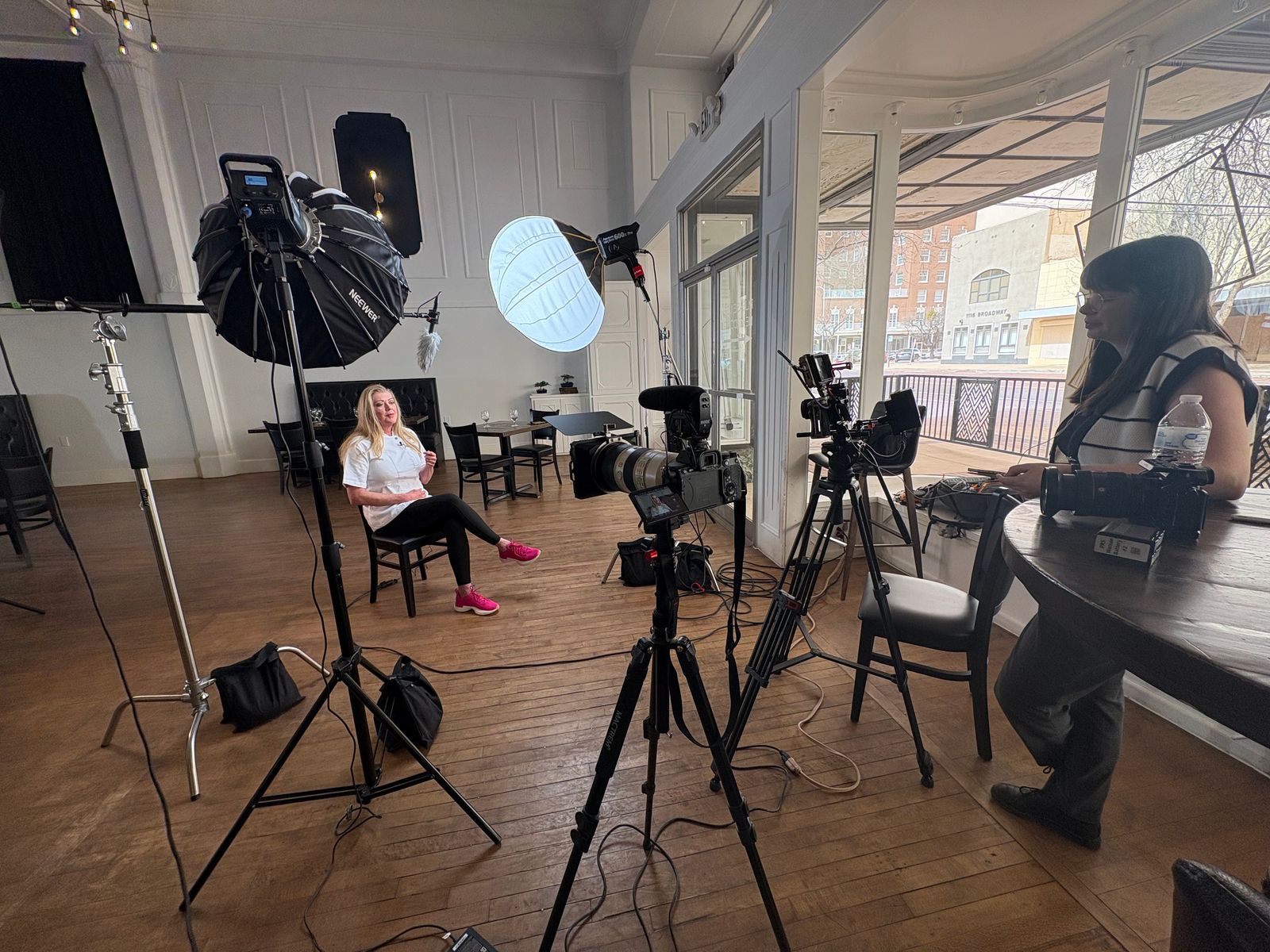
Match the Tier to the Job — Including When That Is Not Us
There are three tiers in practice, and the honest answer is that the cheapest one is sometimes correct.
A freelance videographer is the right call when you need one straightforward piece, you already know what it should say, and you are comfortable directing it. Single-operator work is efficient and there is nothing wrong with it. The trade-off is redundancy: one calendar, one camera, one point of failure, and typically no strategy layer.
A boutique studio earns its cost when the thinking has to happen before the camera comes out, when one shoot day needs to produce several deliverables, or when the video has to integrate with a campaign that already exists. This is where we sit, and it is the right tier for most small and mid-sized businesses — enough production value to look credible, without agency overhead.
A full-service production company makes sense for multi-city shoots, hired talent, union considerations, or a campaign with real media spend behind it, where the production cost is a fraction of the distribution cost.
If you are still deciding whether to outsource at all, our guide on DIY vs professional video covers where self-shot content genuinely works. For what each tier costs, see the video production cost breakdown.
Make the Quotes Comparable
Three quotes at $1,800, $4,500, and $11,000 usually are not describing the same project. Before comparing prices, rewrite all three onto the same lines.
| What to normalize | Why it moves the price |
|---|---|
| Finished pieces and runtime | One three-minute film is a different edit from six thirty-second cuts, even from identical footage |
| Shoot days and crew size | A second operator, a dedicated audio tech, or a producer on set are line items, not assumptions |
| Aspect-ratio versions | Horizontal, vertical, and square are three reframes with three sets of graphics, not one export |
| Captions | Burned-in captions are edit time; an SRT file is not — and each is right for different placements |
| Revision rounds | The most common source of overage, and the number is negotiable before signing, not after |
| Music and licensing | A track cleared for organic social may not be cleared for paid ads |
| Pre-production | Strategy, scripting, and shot lists are either in the quote or they are happening on your shoot day |
Most large gaps close once you do this. The cheap quote is frequently one file, one format, no captions, one revision, and no pre-production — which is a perfectly fair price for what it is, and a bad deal if you assumed otherwise.
One more thing worth asking directly: who is actually on set? Some companies sell with a senior producer and staff the shoot with whoever is available. Ask for the name.
Settle the Rights Before You Sign
This is the section clients most often skip and most often regret, because none of it surfaces until you try to do something with the video two years later.
Copyright. Under U.S. law a video is an audiovisual work — one of the categories that can be a work made for hire, but only if there is a signed written agreement saying so. The U.S. Copyright Office spells this out in its Works Made for Hire circular. Without that language, the production company generally owns the copyright and you own a license. That may be completely fine; you just want to know which one you bought.
Raw footage. Separate from copyright, and usually retained by the producer unless you negotiate it. Ask whether you can buy it, and what it costs. If you ever want a different edit from a different editor, this is the question that decides whether that is possible.
Music. Stock music is licensed by scope, term, and territory. The cheapest licenses often exclude paid advertising. If the video's whole purpose is a paid campaign, confirm the license covers it before the edit is locked.
People. Employees appear in videos and then leave. Releases should cover the channels you actually intend to use, including paid placement, and should survive the person's departure. This matters most in testimonial work, where the person on camera is making a claim about your business.
Red Flags
- A price quoted before anyone asked what the video is for
- "Unlimited revisions" — it reliably means there is no defined process, and open-ended projects drift
- No written scope listing deliverables, formats, and revision count
- A portfolio that is mostly b-roll, drone, and montage, with no one speaking on camera
- Vagueness about who will be on set
- Full payment up front with no milestones
- No pre-production phase at all — they arrive, film, and send files
Hiring Outside Your City
Out-of-market production is normal and works fine, as long as someone on the project knows the location. Insist on advance scouting (photos of the actual rooms, not the lobby), a real pre-production call with everyone who will be on camera, and a producer traveling rather than a camera operator alone. Ask how travel is billed — at cost or marked up — and how review and approval will run remotely.
What local knowledge actually buys you is unglamorous: building access rules, parking for a grip cart, elevator reservations, and knowing which hour of the day that west-facing conference room is unusable. If your project is in our home market, our guide to choosing a corporate video production company in Houston covers those specifics.
A Simple Way to Decide
When the shortlist is down to two or three and they all seem credible, three questions usually separate them:
- Which one asked the best questions? The vendor who wanted to know what happens after someone watches is the one thinking about your result rather than their deliverable.
- Which scope would you be comfortable holding them to? Read it as though the project went badly. Vague scopes protect the vendor.
- Which one told you something you did not want to hear? The willingness to say "that is not the video you need" is the single best predictor of the work being useful.
That is most of it. The reel gets you to the shortlist; the scope, the rights, and the questions they ask get you to the right choice.
Frequently Asked Questions
What questions should I ask a video production company before hiring?
Ask what the deliverable list is (how many finished pieces, at what runtime, in how many aspect ratios), how many shoot days and crew are included, how many revision rounds you get, whether captions and music licensing are included, who owns the raw footage and the copyright, and who specifically will be on set. The answers, not the reel, are what actually differ between vendors.
How do I compare video production quotes that are wildly different?
Rewrite all three onto the same six lines: finished pieces and runtime, shoot days and crew size, aspect-ratio versions, captions, revision rounds, and licensing. Most large price gaps close once you do this, because the cheap quote is usually one file in one format with one revision and no pre-production, while the expensive one includes strategy, multiple cutdowns, and platform versions.
Who owns the footage after a video project?
It depends entirely on what the contract says. Under U.S. copyright law a video is an audiovisual work, which can be a work made for hire — but only with a signed written agreement saying so. Without that language, the production company generally holds the copyright and you hold a license to use the finished video. Raw footage is a separate question again, and is often retained by the producer unless you negotiate for it.
Should I hire a freelance videographer or a video production company?
If you need one straightforward piece, you already know what it should say, and you can direct it yourself, a good freelancer is often the right call and a full studio is overkill. A production company earns its cost when the project needs strategy before the camera comes out, multiple deliverables from one shoot day, or coordination across locations, talent, and channels.
Does a video production company need to be local?
Not necessarily, but someone on the project should know the location. Out-of-market production works when the company scouts in advance, runs a real pre-production call with everyone who will be on camera, and sends a producer rather than just a camera operator. What you are paying for locally is logistics — building access, parking, permits, and the hour of daylight that actually works in that space.
Comparing options right now? Book a free strategy call — I will give you an honest read on what your project needs and what it should cost, including when a smaller vendor is the better fit. If we are the right match, our full-service video production starts with the strategy conversation, and the process is written down before anyone picks up a camera.