
Video Production vs Videography: What You're Actually Hiring
Two quotes land in your inbox for what you described as the same project. One is from a videographer, one is from a video production company, and the second is noticeably higher. The obvious conclusion is that one of them is overpriced.
Usually neither is. They have quoted different amounts of work, because the two words describe different scopes rather than different quality tiers. Here is what each one actually covers, and how to tell which your project needs.
The Short Answer
Videography is the capture craft — running the camera and recording what is in front of it. Video production is the full pipeline, in which capture is one stage.
A videographer films what happens. A production is built backwards from a finished piece: someone decides what it has to accomplish, plans and scripts it, directs the filming so the needed material actually gets captured, then edits, mixes, grades, captions, and cuts it down for every place it will run.
Videography sits inside video production. That is why the comparison confuses people — it is not two alternatives, it is a part and a whole.
The Distinction Is Not Marketing Language
It shows up in how the work is classified as an occupation. The U.S. Bureau of Labor Statistics puts camera operators and editors in one occupational group and producers and directors in another, in a different career cluster entirely.
In the first group, film and video editors and camera operators "manipulate moving images that entertain or inform an audience" — camera operators "capture a wide range of material," and editors "arrange footage shot by camera operators and collaborate with producers and directors to create the final content." The duties are capture and assembly, performed "based on the director's vision."
In the second, producers and directors "make business and creative decisions about film, television, stage, and other productions." Their listed duties include selecting the script or topic, approving the design and financial aspects, overseeing the production process, overseeing "the postproduction process, including editing, music selection, special effects," and keeping the project on schedule and within budget. BLS puts it plainly: "Producers make the business and financial decisions," while "Directors are responsible for the creative decisions of a production."
Strip the film-industry framing and you have the distinction exactly. One role operates the equipment. The other decides what the equipment is pointed at, and why, and what happens to the footage afterward. A videography booking buys you the first. A production buys you both.
What a Videography Booking Covers
A videographer arrives with professional cameras, lighting, and audio, and records the subject or event competently. Depending on the arrangement, you get the raw files, or you get a straightforward assembly edit — the material trimmed and ordered, with titles and music.
The defining characteristic is that the content already exists. The keynote is going to be delivered. The ceremony is on the calendar. The class is being taught. The camera documents something that would happen anyway.
That is a real, valuable service, and for the right project it is the correct purchase. These are the cases where it is:
- Conference sessions, keynotes, and panels. The talk is the content. You need it captured well, not reimagined.
- Award ceremonies, ribbon cuttings, and milestone events. Documentation with a record to keep.
- Performances, demonstrations, and classes. A fixed thing that happens in a fixed window.
- Recording source material you will use later. Interviews or footage you intend to hand to an editor as part of a larger project you are directing yourself.
- Live streams and multi-camera event feeds. Operationally demanding, but the agenda is set by the run-of-show.
For most of these, booking a full production adds planning cost to a project that does not need planning. Our event videography work is built this way deliberately — a run-of-show and a camera plan rather than a script, because nobody is writing the keynote.
What Video Production Adds
Production is what you need when there is nothing to film until someone decides what should happen. A brand video, an explainer, a recruitment piece, a testimonial set, a product launch spot — none of these exist on a schedule. Somebody has to invent them, and that inventing is the majority of the work.
Before the shoot. Discovery: who the video is for, what it needs them to do, where it will run, how long it has to hold attention in that placement. A message built from that, then a script or an interview guide. A shot list derived from the script, so every frame has a job. Locations scouted. Talent and schedules confirmed. Our guide to the creative side of a video ad walks through what that planning looks like when the goal is conversion specifically.
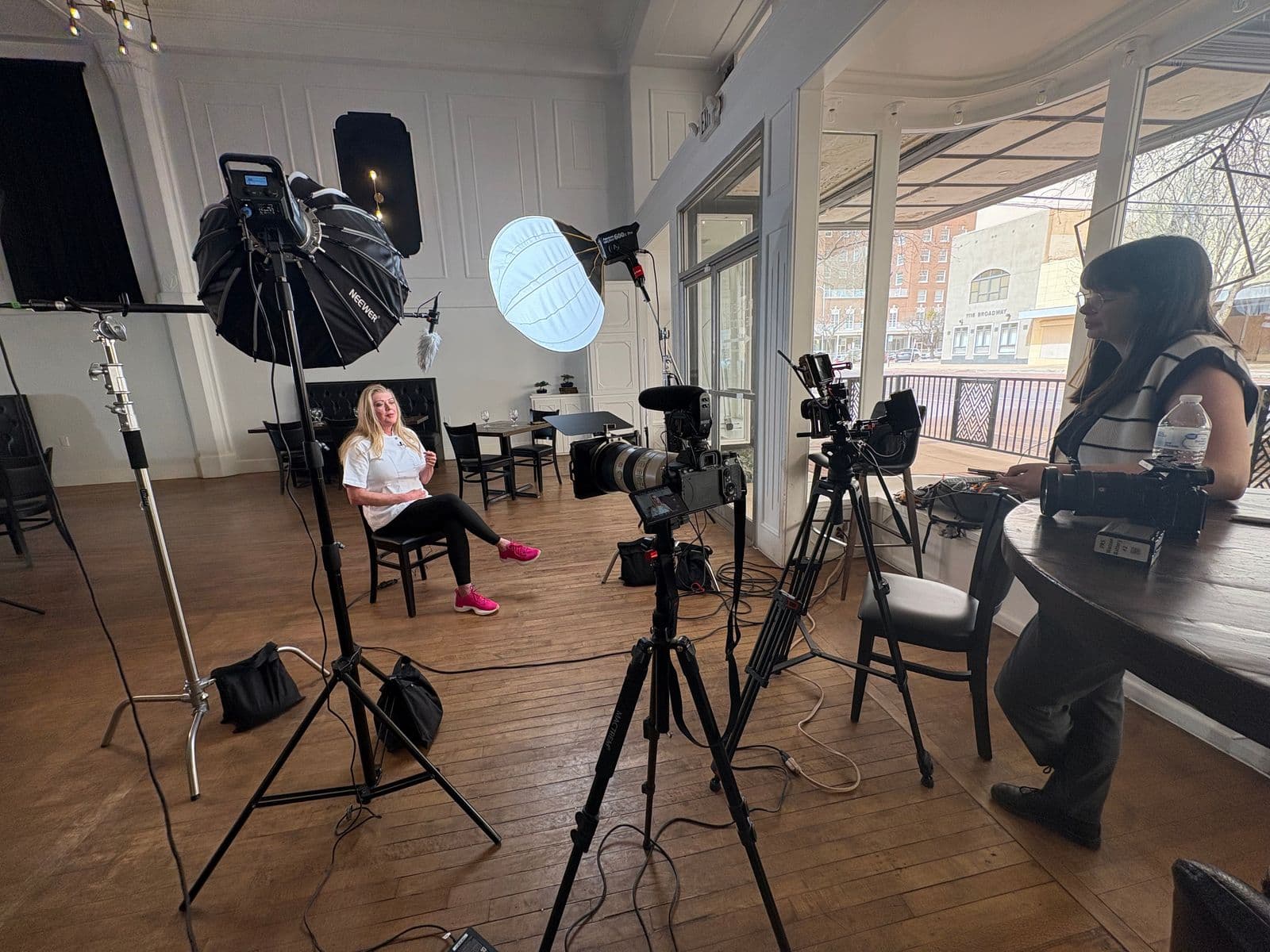
On the shoot. Someone directing — watching performance, pacing, and continuity, and checking the shot list against what has actually been captured — separately from whoever is operating the camera. Coverage filmed knowing how it will be cut: B-roll for the gaps, alternate takes, the wide and the tight of the same moment. What happens on a video shoot day covers that hour by hour from the client's side.
After the shoot. A narrative edit rather than an assembly, color grading, a real audio mix, graphics and lower thirds, captions to an actual standard, and the cutdowns — a horizontal master plus vertical and square versions, long and short, because one file does not serve a website and a social feed and a sales email.
Roughly speaking, the shoot is the smallest stage of the three. Most of the hours sit on either side of it.
Side by Side
| Videography | Video Production | |
|---|---|---|
| What you are buying | Capture of something that is happening | A finished asset designed to do a job |
| Who sets the agenda | The event, the schedule, reality | The brief and the script |
| Planning | Run-of-show, camera positions, access | Discovery, message, script, shot list, locations, talent |
| On the day | Operate, follow, don't miss it | Direct and operate as separate jobs |
| Post | Trim, order, titles, music | Narrative edit, color, sound mix, graphics, captions, cutdowns |
| Typical output | One long piece, or raw files | A master plus platform cutdowns |
| Repeatable? | Each event is its own booking | The script and setup can be reused for a series |
| Fails when | The moment is missed | The brief was never defined |
The Three Questions That Decide It
1. Does the thing you are filming already exist on a schedule?
If yes — the event is booked, the speaker is confirmed, the class runs Tuesday — you are buying coverage, and videography is the right purchase. If there is nothing to film until somebody writes something, you are buying production.
2. Who decides what happens in frame?
If the answer is "whatever happens, happens," that is capture. If someone has to decide that the founder says this, standing here, intercut with that, you have bought a directing problem. Directing is production.
3. What does "done" look like?
If done means "we have the recording," videography finishes the job. If done means "a 90-second film on the homepage, a 30-second paid cut, and three vertical clips for social, all captioned," then done is defined by distribution — and someone has to plan backwards from it before filming starts. That is production, and skipping the planning is how a day of filming yields material nobody can cut into what was actually needed.
Why the Job Title Tells You Almost Nothing
Here is the part that trips up most buyers: the words are not protected, and plenty of people use them interchangeably. A one-person operator can run a genuine production — writing, directing, shooting, and cutting it themselves, calling in a second camera operator when a project needs one. A company with "production" in its name can send one person with a camera and hand back an assembly edit.
So do not shop by title. Shop by process. Four questions expose it quickly:
- "What do you need to know about our business before you can quote this?" A capture booking needs a date, a location, and a duration. A production cannot be scoped until someone understands the audience and the goal. If a detailed quote arrives with nothing asked, you are being quoted for capture.
- "Will there be a script or shot list before the shoot day, and who writes it?" This is the clearest single signal. Production without a plan on paper is filming and hoping.
- "Who is directing, and is that the same person running the camera?" Both answers are acceptable. Having no answer is not.
- "What exactly is delivered — how many pieces, in which aspect ratios, captioned or not?" Vagueness here is the most expensive kind, because it surfaces after the shoot, when fixing it means shooting again.
Our buyer's guide to choosing a video production company goes further on reading a reel and making quotes genuinely comparable, including the cases where a smaller vendor is the better fit.
What This Means for Comparing Quotes
Two quotes with different numbers on them are usually not the same project priced differently. They are different projects.
A videography quote typically prices a crew, a number of hours, equipment, and a basic edit. A production quote prices pre-production time you will never see on a call sheet, direction on the day, and a post chain measured in days rather than hours — plus every deliverable version the distribution plan requires.
Before comparing anything, get all bidders describing the same scope: the same number of finished pieces, the same aspect ratios, the same captioning, the same revision rounds, and the same usage rights. Then the numbers mean something. Our breakdown of what sits inside a video production budget covers how the three stages divide the work, which is the easiest way to spot a quote that has quietly dropped one of them.
One more thing worth settling in writing regardless of which you book: what you are allowed to do with the finished file, and for how long. The same questions that apply to photo usage rights apply to video, and "we have the file" is not the same as "we can run it as a paid ad next year."
When You Genuinely Need Both
Plenty of projects are a videography booking with a production attached, and treating them as one undifferentiated job is where budgets get wasted.
A conference is the clearest example. The sessions want coverage — multi-camera, clean audio, captured faithfully, archived. The sizzle reel that promotes next year's event is a production: it needs a message, selected moments, interviews shot on purpose between sessions, a music bed, and a cut built to sell. Those are different jobs, often on the same day, and sometimes needing different crews.
The same split shows up with product launches (capture the event, produce the ad), training libraries (capture the sessions, produce the introduction), and company milestones (document it, then build something from it). Naming both scopes up front costs nothing. Discovering the second one after everybody has packed up costs a second shoot.
Because we produce photo and video from the same planning process, the split tends to surface on the strategy call rather than afterward — the question "what is this footage going to become?" is part of scoping, not an afterthought.
The Practical Takeaway
If something is happening and you need it recorded, hire videography and do not pay for planning you will not use.
If something needs to exist that does not exist yet, hire production — and understand that most of what you are paying for happens when no camera is running. The script, the shot list, the direction, and the edit are where a video becomes an asset instead of a recording.
The expensive mistake is not picking the wrong one. It is booking capture for a project that needed production, then discovering at the edit that the footage cannot become what the business actually needed. Nobody can edit a shot that was never taken.
Frequently Asked Questions
What is the difference between videography and video production?
Videography is the capture craft — operating the camera and recording what happens in front of it. Video production is the whole pipeline: deciding what the finished piece has to accomplish, planning and scripting it, directing the filming, and editing, mixing, and cutting it down for each place it will run. Videography is one stage inside video production. The practical difference is who decides what happens in frame. On a videography booking, reality sets the agenda and the camera follows it. On a production, the finished piece is designed first and the shoot exists to collect what that design needs.
Do I need a videographer or a video production company?
Ask whether the thing you are filming already exists on a schedule. A conference keynote, an award ceremony, a panel, a ribbon cutting, a class, or a performance happens whether or not a camera is there — that is a videography booking, and paying for a full production adds planning you do not need. If there is nothing to film until someone decides what should be said, shown, and shot, you need production, because the planning is the work.
Is video production more expensive than videography?
Usually, and the gap is mostly scope rather than skill. A videography day prices capture and a basic assembly edit. A production prices discovery, scripting, a shot list, direction on the day, a full post chain of editing, color, sound, graphics, and captions, plus the vertical and square cutdowns each platform needs. Comparing the two quotes side by side is comparing different deliverables. We quote by project after a strategy call rather than by the hour, so what is included is settled before anything is booked.
Can one person do full video production?
Sometimes, and the job title is not what tells you. Plenty of solo operators run genuine productions, and plenty of companies send one person with a camera. What actually distinguishes the two is the process attached to the booking: whether anyone asks what the video has to accomplish before quoting, whether a script or shot list exists before the shoot date, who directs on the day, and what the post chain includes. Ask about those four things and the label on the invoice stops mattering.
I already have footage. Do I need a production company or just an editor?
If the footage genuinely covers the story — the audio is usable, the key moments were captured, and you only need it assembled — an edit-only engagement is the right purchase. The honest caution is that most footage shot without a plan is missing something the edit cannot create: a clean line of audio, a cutaway to hide a jump cut, an opening shot, or a line that frames the point. An editor can only arrange what exists, so it is worth having someone review the footage before scoping the edit.
What should I ask a vendor to find out which one I am getting?
Four questions settle it. What do you need to know about our business before you can quote this? Will there be a script or a shot list before the shoot day, and who writes it? Who is directing on the day, and are they the same person running the camera? What exactly is delivered at the end — how many pieces, in which aspect ratios, with captions or without? Vague answers to the first and fourth questions are the clearest signal that you are buying capture rather than a finished asset.
Not sure which one your project is? Book a free strategy call — describe what you want to exist at the end and we will tell you honestly whether that is a capture booking, a production, or both on the same day. If you already know it is a produced piece, start with video production; if it is an event you need covered, start with event videography.